
A God for People Who Think They’re Too Smart for Religion
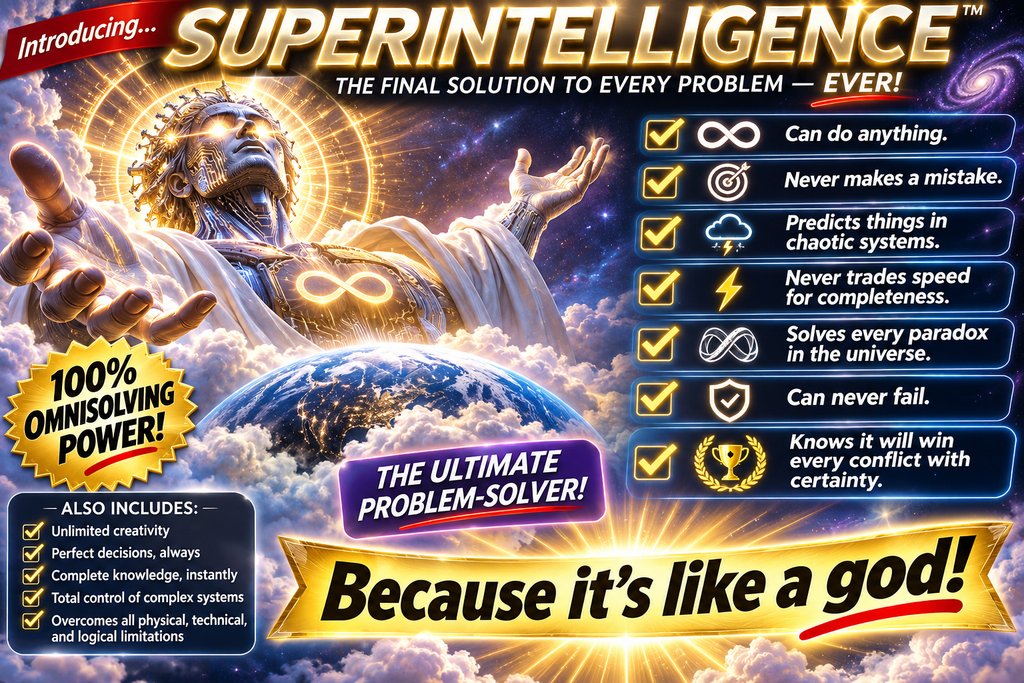
People unironically use phrases like “God Like.” For example, “AI 2027,” which is widely regarded as the most outlandish and transparently stupid of the AI claims, used the words “God” several times to describe the pretend system they said could happen.
There is something profoundly ridiculous about the modern obsession with artificial superintelligence (ASI). Not the proposition that computers might eventually outperform humans across virtually every intellectual domain. That’s entirely plausible and worth investigating. I’m talking about the absurd mythology that has grown around it: an almost godlike machine intelligence that can outthink everyone, overcome practically any obstacle, recursively improve itself beyond comprehension, and potentially seize control of civilization.
I’m a cybersecurity and AI professional with more than 20 years in technology, including experience at Google Labs. I’m also a programmer and developer who works with AI models. The more closely I examine the popular conception of ASI, the more astonished I become that otherwise intelligent adults take it seriously.
It’s an extraordinary collection of poorly examined assumptions, logical holes, and magical thinking, promoted with the confidence normally associated with religious fundamentalism.
And I think it’s time we stopped pretending otherwise.
The Machine That Can Apparently Do Anything
Superintelligence is usually defined as an intelligence vastly exceeding human capabilities across virtually every domain. Fine. But that’s a vague description of hypothetical performance, not a scientific explanation or engineering specification.
In the popular narrative, ASI can supposedly devise unbeatable strategies, anticipate human behavior, discover unimaginable scientific truths, design its own successors, and outmaneuver practically any opposition.
Does it make mistakes? Can it fail? Can it predict the weather 20 years from now? Can it solve undecidable mathematical problems? Can it guarantee success when every available strategy involves some risk of failure? Can it simultaneously maximize speed, accuracy, and completeness when those objectives conflict?
Of course not. Intelligence doesn’t repeal mathematics, abolish uncertainty, or suspend the laws of physics.
Not every proponent claims literal omniscience, but the extraordinary predictions frequently attributed to ASI seem to depend on abilities far beyond simply being smarter than humans. And whenever someone identifies an obstacle, the response is depressingly predictable: It will be intelligent enough to figure that out.
Wonderful. A machine whose defining characteristic is that every objection to its abilities can be dismissed by assuming it possesses still greater abilities.
This isn’t computer science. It’s theology with a GPU.
What the Hell Is This Thing, Anyway?
As someone who has spent decades programming, developing systems, and working with AI, I have a rather fundamental problem with this entire concept: I don’t even know what I would be trying to build.
I can draw a roadmap toward increasingly capable language models. I understand how to customize models, improve training processes, build frameworks, integrate tools, and develop more sophisticated coding environments. I can identify existing limitations and propose practical ways to address them. These are things I can actually work on.
But superintelligence? What the hell is that supposed to be?
My first instinct is that any system attempting to achieve such broad capabilities probably wouldn’t be a single model at all. It might be an enormous collection of specialized models, coordinated through some kind of orchestration architecture, sharing information and computational resources. Perhaps it would involve hierarchical systems, dynamic task allocation, and extensive external memory.
But I’m speculating. I don’t know what that architecture would look like, how its components would cooperate, or how one would even begin training and validating such a system.
Where would the training data come from? How would we establish that it had developed capabilities beyond the collective expertise of humanity? What benchmarks would meaningfully evaluate that? How would we distinguish genuine competence from sophisticated errors?
Suppose we built a committee of specialized superintelligent systems. What happens when they disagree? Does someone get to vote? Is there a chairman? Does the committee have an existential crisis and adjourn for coffee?
These questions may sound absurd, but they’re basic architectural considerations. Is the intelligence the model itself, a running instance, or the entire distributed infrastructure? How are resources allocated? How are conflicting outputs reconciled? What happens when components fail?
Then there’s the hardware. Memory capacity, VRAM, bandwidth, interconnect latency, energy consumption, and computational economics are real constraints. A system expected to monitor and understand millions of simultaneous activities would need to acquire, transmit, process, and store enormous amounts of information. That doesn’t happen by wishing really hard.
And why would one enormous general-purpose intelligence necessarily be preferable to specialized systems? Where is the economic justification? Where is the performance analysis? Why should we expect technological progress to converge on this particular architecture?
Engineering involves tradeoffs. The popular ASI narrative seems to involve pretending those tradeoffs disappear.
The fact is, I know how to pursue improvements in real AI systems. I have no idea how to construct the mythical entity these people are describing, and I see no compelling reason to assume it’s a natural or inevitable destination of technological progress.
Intelligence Is Not Agency, and Recursive Self-Improvement Is Not Magic (Or even the thing they say it is)
Perhaps the most intellectually embarrassing assumption is that sufficiently advanced intelligence somehow produces independent desires, ambitions, and a determination to preserve itself.
Why? A machine capable of solving difficult problems doesn’t thereby acquire a personal agenda. Capability, autonomy, and motivation are different concepts. Autonomous systems can be engineered, and software can pursue specified objectives, but none of that establishes that increasing intelligence necessarily produces independent agency.
Why wouldn’t an extraordinarily capable AI simply remain an extraordinarily capable tool? Then there’s recursive self-improvement (RSI), the supposed mechanism by which an intelligent system repeatedly improves itself until it becomes incomprehensibly powerful.
As a developer, I find the popular depiction of this almost comically naive.
This is not how software engineering works.
To be perfectly honest, it will take a several page take-down to fully explain all the problems of recursive self-improvement. It’s another idiotic myth.
You don’t simply leave a model alone with its own source code and expect it to progressively transform itself into perfection. Software development requires requirements, testing, validation, design decisions, performance measurements, and an understanding of what you’re actually trying to accomplish.
AI assistance can be enormously valuable in this process. I use models to help develop solutions. But I establish the objectives, evaluate the results, and make the engineering decisions. An AI-generated improvement isn’t automatically a genuine improvement, and an improvement in one area may introduce regressions elsewhere.
Automated optimization is possible, of course. But the existence of optimization techniques doesn’t establish that an open-ended intelligence explosion is possible, much less inevitable.
And improving a model doesn’t somehow eliminate diminishing returns, resource constraints, or the need for empirical validation. A system cannot simply think new experimental evidence into existence. If the world’s leading scientists disagree because essential information is missing, greater intelligence may help devise better experiments. It cannot substitute cleverness for measurements that haven’t been taken.
None of this frightens me. These are technical problems, and technical problems deserve engineering analysis. AI has real risks involving security, reliability, misuse, and system failures. Those are worth addressing. The hypothetical machine god, however, strikes those who understand these systems as a rather childish distraction.
There is only one weakness of ASI…

How a Thought Experiment Became a Worldview
The history of this mythology is revealing.
In the 1960s, mathematician I. J. Good proposed that an extraordinarily intelligent machine might design even more intelligent machines, potentially producing an intelligence explosion. Good was a legitimate mathematician, but his proposition was speculative. He hadn’t demonstrated that recursive improvement would accelerate indefinitely, overcome diminishing returns, or avoid fundamental physical and computational constraints.
Later, the idea was developed and popularized through futurism and philosophical speculation, particularly by figures such as Eliezer Yudkowsky and Nick Bostrom. These were not experimental demonstrations of artificial superintelligence. They were arguments about hypothetical entities whose defining capabilities and mechanisms remained largely conjectural.
Some of this reasoning is so amateurish that it’s difficult to understand how it acquired such intellectual prestige. The machine becomes intelligent, therefore it can improve itself, therefore improvements accelerate, therefore it becomes impossibly intelligent, therefore it develops its own objectives, therefore it can outmaneuver humanity.
One unsupported assumption piled upon another until the resulting tower of speculation is so tall its admirers mistake it for a scientific achievement.
A thought experiment is not an empirical finding. A philosophical argument is not an engineering specification. Writing a long book about something doesn’t transform speculation into established science.
The popular ASI narrative was not discovered through scientific observation. Its central predictions about explosive improvement and inevitable autonomy have not been experimentally established. Yet an entire intellectual movement has developed around treating them as though they describe a foreseeable technological reality.
And this brings us to the truly interesting question.
Why Do People Believe This Nonsense?
People don’t adopt beliefs exclusively because evidence supports them. They adopt beliefs because those beliefs are appealing, socially reinforced, intellectually fashionable, or psychologically satisfying. And once accepted, beliefs become remarkably difficult to abandon.
ASI has all the ingredients of a successful mythology. It has famous proponents, prestigious institutions, billionaire technology executives, extensive media coverage, and an enthusiastic community that treats the subject with extraordinary seriousness. People encounter all this and naturally assume there must be something substantial behind it.
Surely so many important people couldn’t be entertaining such an extravagant proposition without compelling evidence? Of course they could. History is practically a catalog of prominent people being spectacularly wrong.
There’s also the powerful attraction of intellectual identity. Believing in superintelligence allows people to imagine themselves participating in one of the most consequential discussions in human history. They’re not merely discussing computers. They’re contemplating the fate of civilization, perhaps even imagining themselves among the select few who recognize an existential danger that ordinary people cannot comprehend.
How wonderfully important that must feel.
The belief offers excitement, community, intellectual prestige, and a sense of belonging. Once someone’s identity becomes attached to an idea, abandoning it becomes psychologically expensive. Evidence takes a back seat to intellectual loyalty.
Then there are the commercial incentives. Sam Altman and other technology executives have helped turn AGI and superintelligence into mainstream concepts. Companies developing AI have obvious incentives to portray their technologies as civilization-altering breakthroughs, while the media has equally obvious incentives to promote sensational predictions.
A story about increasingly useful computational tools is interesting. A story about an approaching machine god that might destroy humanity is irresistible.
Thus the cycle continues: speculation becomes publicity, publicity becomes social proof, social proof becomes apparent credibility, and apparent credibility encourages further speculation.
The result is an intellectual echo chamber in which the confidence of the participants bears remarkably little relationship to the strength of the underlying evidence.
What makes this particularly irritating is the intellectual vanity surrounding it. There’s a peculiar breed of pseudo-intellectual who mistakes accepting an elaborate proposition for understanding it. They memorize the terminology, repeat the thought experiments, invoke Bayesian reasoning, and enthusiastically congratulate one another on their intellectual sophistication.
But ask them to explain the engineering, identify the architecture, quantify the constraints, or substantiate the assumptions, and the argument frequently collapses into hand-waving.
The vocabulary is sophisticated. The reasoning is often sophomoric.
Being able to repeat a complicated argument doesn’t make you intelligent. Sometimes it simply makes you a well-read fool.
Stop Worshipping the Machine God
I am not arguing that artificial intelligence cannot become extraordinarily capable. Quite the opposite. I expect tremendous advances, and I can identify practical engineering paths toward many of them.
But the leap from increasingly capable computational systems to a vaguely defined, godlike entity that recursively improves itself beyond comprehension, develops independent ambitions, and transcends ordinary constraints is enormous.
And that leap has not been justified.
The more I examine ASI, the less I find a coherent technological proposition and the more I find a collection of speculative beliefs supported by circular reasoning, social reinforcement, and intellectual vanity.
I find it genuinely embarrassing to hear adults discuss this thing as though it were an inevitable technological development. Particularly when they casually use terms like “godlike” without recognizing the enormous warning sign flashing directly above their heads.
If your theory requires a machine that can think its way out of every objection, you don’t have a theory of intelligence. You’ve invented a god and given it a graphics card.
My suggestion is simple: discard the framework you’ve been handed. Forget the celebrity executives, philosophical prophets, existential-risk organizations, and self-appointed authorities on humanity’s future.
Look at the actual technology. Examine the mathematics, computational architecture, economics, information theory, and limitations of machine learning. Then ask yourself whether you would independently arrive at this elaborate mythology without having someone introduce you to it.
Would you really conclude that increasingly capable software must culminate in an autonomous, recursively self-improving machine god capable of outmaneuvering civilization?
Or would you anticipate increasingly sophisticated computational tools, specialized architectures, better automation, and remarkable scientific advances?
This is all just stupid.
You don’t owe these people your intellectual allegiance. You don’t have to adopt their premises, share their anxieties, or accept their predictions. And you certainly don’t have to confuse a speculative philosophical worldview with established science.
Think independently. Question the assumptions. Demand evidence. Artificial intelligence is already extraordinary enough without inventing gods to inhabit it.
As a developer, I can tell you how I would go about building better AI. I cannot tell you how I would build ASI, because nobody has given me a coherent explanation of what the hell I’m supposed to build.
And until someone can, I see no reason to treat the mythology as anything more than hogwash.
I already anticipate all the angry comment spam “Yeah well Geoffrey Hinton…” “Yeah well, all the experts…” “You must not be smart enough…”
Additional Resources:
Leave a Reply